
25 May Auto Electrical System Part 4: Engine Control Unit
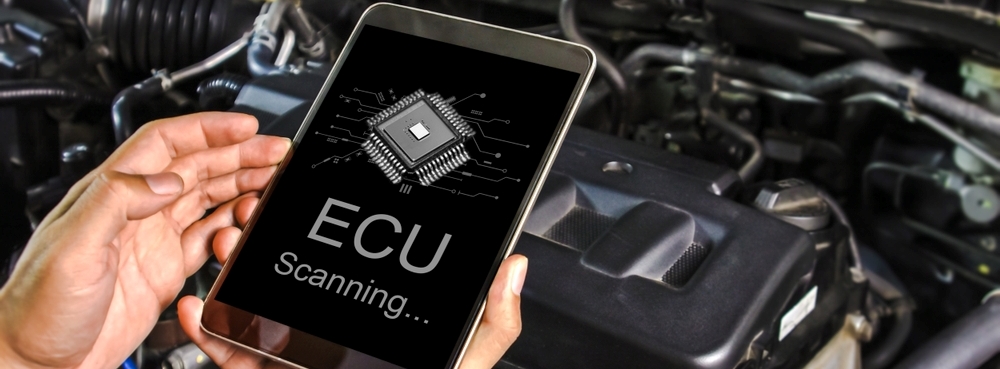
 This multi-part blog series breaks down a vehicle’s electrical system into easy-to-understand chunks. Part 1 was an overview of the basic principles of your auto electrical system. Part 2 discussed the ignition & starter, auto lights, and auxiliary systems. Part 3 detailed the importance of car fuses in your vehicle’s electrical system. Part 4 focuses on the engine control unit (ECU) and how it works with your vehicle’s on-board computers to run the electrical system.
What Are On-Board Computers?
Back in the day, cars and trucks used mechanical systems to regulate a vehicle’s idle speed, valve timing, and fuel delivery. Today, modern automobiles use multiple electronic valves, actuators, and sensors connected to mini-computers to ensure the various systems operate correctly. These on-board computers are part of your vehicle’s electrical system and include the ECU/ECU, TCM, and PCM.
Engine Control Unit or Module (ECU/ECM)
The ECU interprets data from various sensors and determines if any system requires adjustments to create optimal performance conditions. This type of electronic module controls multiple vehicle systems. Depending on the vehicle design, this may include only engine components, such as the ignition, fuel injection, and airflow. Other vehicle designs expand the ECU’s function to control additional components, such as the ABS, airbags, cruise control, and the HVAC. At vehicle startup, the ECU performs a comprehensive systems check. It collects data from numerous sensors, including:
- Air-fuel sensors
- Coolant temperature sensors
- Crankshaft and camshaft position sensors
- EGR valve sensors
- MAF sensors
- Oxygen sensors
- Throttle position sensors
Transmission Control Module (TCM)
The TCM assists with gear shifting in automatic transmission vehicles. The transmission control module collects data from numerous sensors, allowing the transmission to change gears efficiently and increase performance and fuel efficiency. Additionally, the TCM also monitors acceleration, road slope, vehicle speed, and deceleration for better vehicle control. The TCM interprets data from numerous sources, including:
- Throttle position sensors
- Transmission fluid temperature sensors
- Turbine speed sensor
- Vehicle speed sensors
- Wheel speed sensors
Powertrain Control Module (PCM)
A powertrain control module monitors and controls your vehicle’s emissions, transmission, and charging systems. In some cars, it also oversees the driveline and engine. The PCM is an advanced on-board computer that handles more operations than the ECU and TCM do individually. Like all control modules, the PCM makes rapid system adjustments to ensure optimal engine efficiency and performance. The PCM collects data from your vehicle’s sensors to control the following components and systems (among others):
- ABS braking
- Air-to-fuel ratio
- Battery charging rate
- Electronic differential performance
- Emissions
- Fuel injection
- Idle speed
- Ignition timing
- Shifting RPMs
- Variable valve timing
What Happens When My Engine Control Unit Goes Bad?
For most vehicles containing on-board computers, there are signs to indicate the ECU is malfunctioning. Let’s review a few.
Dashboard Warning Lights
When issues arise in your vehicle’s electrical system that the control modules cannot correct, it generates an error code. The error code will illuminate a dashboard warning light to signal you, the driver, that a problem exists. It is then up to you to fix the problem. The simplest solution is to schedule a diagnostic appointment with your mechanic so that they can determine the issue.
Engine Won’t Start
If the issue is severe enough, your vehicle may shut down and not start to protect itself from more damage. Another safety feature, called ‘limp mode’ reduces your vehicle’s acceleration and RPMs. In theory, this allows you to drive directly to a repair shop without completely turning off your vehicle. Other symptoms of a bad control unit may include:
- Difficulty starting
- Misfires
- Rough Idle
Poor Gas Mileage
Poor gas mileage occurs when the air-to-fuel mixture is off. Any number of sensors can contribute to this issue. A fuel mixture that is too rich can also create an emissions issue. If you suspect your gas mileage has changed, bring your vehicle in for service and discuss your concerns with your technician.
Rough Shifting
A malfunctioning TCM on older vehicles or PCM on newer models can affect the transmission performance. Symptoms like rough or delayed shifting can be hazardous when accelerating onto the highway. The transmission warning light may also illuminate under these circumstances.
On-Board Computers Maintenance
Auto manufacturers often issue software updates for the various on-board computers in their vehicles. These updates can correct minor bugs, malfunctions, or other complications with the engine control unit and other modules. Performing routine maintenance at a qualified auto service center like Ron’s Garage in Ann Arbor, MI, can help mitigate software issues in your vehicle’s electrical system. Our experienced technicians utilize state-of-the-art diagnostic tools to accurately diagnose ECU trouble and minimize unnecessary labor costs.
Make An Appointment
Call us at (734) 662-8379 or visit our website to make an appointment with our service writer.